How to Build a Website with ChatGPT: 3 Ways Compared
Published
On this page
Asking ChatGPT for a website is easy. Getting that website to a URL other people can open, with a contact form that actually reaches your inbox, is where the question usually stalls.
There are three realistic answers, and they are good at different things. This guide compares them honestly, then walks through the one that needs the least setup.
The three options at a glance
| Copy the HTML, host it yourself | ChatGPT for copy, a site builder for the site | App (FormEdge) | |
|---|---|---|---|
| Setup needed | A hosting account, and files to move | A builder account, and manual assembly | One app, approved once |
| Who publishes | You upload or deploy | You, in the builder | ChatGPT, from the conversation |
| Editing later | Ask again, replace the files | Edit in the builder | Ask ChatGPT, or use the dashboard |
| Contact form | No place to store replies | Whatever the builder provides | Included — replies are stored, and emailed once you set an address |
| Good for | Full control over the markup | Picking a design you like | Getting a real page live without code |
None of these is "the best one". Pick by what you are actually trying to do.
Option 1 — Copy the HTML and host it yourself
Ask ChatGPT for a one-page site and it will write the HTML and CSS in the conversation. You copy that out, save it as a file, and put it on a static host.
What it is good at: you own every line, static hosting is inexpensive, and you can take the files anywhere later.
Where it breaks: moving the files is your job, and so is every later edit. And a contact form still needs a backend — a static host will serve your HTML, but it will not store what someone types into it. That is usually the step people underestimate.
Option 2 — ChatGPT for the words, a site builder for the site
Use ChatGPT the way it is strongest — headlines, section copy, service descriptions — and paste the result into a website builder that handles hosting and forms.
What it is good at: you get a design that was made to look finished, and the form usually works out of the box.
Where it breaks: it is manual. Every revision means another round of copying between two windows, and the builder's structure, not your conversation, decides what fits.
Option 3 — An app: ChatGPT publishes the page for you
An app gives ChatGPT a way to operate another service directly from your conversation. FormEdge is listed in the ChatGPT app directory and exposes its tools over MCP, so ChatGPT can build the page, save it as a draft, hand you a preview link, and publish it once you approve — while the form on that page stores submissions, and emails you about them once you set a notification address (the last step).
What it is good at: nothing to copy, no deploy step, and the form works on the first try.
Where it breaks: you are working inside one service's page builder rather than arbitrary code, and connecting an AI agent requires a paid plan.
Walkthrough: publishing with the app
Create a FormEdge account
Sign up with an email address. The free plan is enough to build and publish a page from the dashboard; the app connection in the next step is what needs Starter.
Connect FormEdge in ChatGPT
In ChatGPT, open Settings > Apps and find FormEdge in the directory, then connect it — it is listed, so there is no URL to type. ChatGPT sends you to FormEdge to sign in.
If it does not appear in the list, you can register the server URL by hand instead (this needs developer mode in ChatGPT).
Server URL
https://mcp.formedge.app/mcp
Approve what ChatGPT may do
The first time you ask ChatGPT to do something, FormEdge answers that the connection is not approved yet, and ChatGPT passes you a link to the approval page. There you choose the workspace and the scopes ChatGPT gets. Approve, then ask again. Those scopes are the whole boundary, so grant narrowly:
- Grant create and edit — they are off by default, and without them ChatGPT has nothing to build the page with.
- Leave publishing out if you want to review and publish yourself; you can add it later.
- Grant the notification settings scope if you want ChatGPT to set where new submissions are sent (the last step uses it). It is off by default; without it, set the destination in the dashboard.
- Delete permissions are off by default and cannot be undone. There is an unpublish action for taking a page offline, so you rarely need delete at all.
You can change or revoke this later under Settings > External app connections in the dashboard.
Describe the site and ask for a preview
Give ChatGPT the facts rather than letting it invent them, and ask it to stop before publishing.
Prompt to paste
Build a one-page site in FormEdge for my business.

- Name: (e.g. Maple Street Hair Studio)
- What we do: (e.g. a two-chair salon, cuts and color, one stylist at a time)
- Address: (e.g. 456 Maple Street, Springfield)
- Phone: (e.g. +1 (555) 555-0176)
- Hours: (e.g. 10 AM to 7 PM, closed Sundays and Mondays)
- Prices: (e.g. haircut $65, color from $120, treatment from $40)
- What makes us different: (e.g. every appointment starts with a consultation, and we never double-book chairs)

Sections: intro, services and prices, how to find us, and a contact form for appointment requests.
Contact form fields: name, email, service requested, and what they would like.

Do not publish it yet — give me a preview link first.
Read the preview before you trust it
Open the preview on a phone as well as a desktop — most people will find a salon on a phone — and check the things ChatGPT could not have known:
- Hours, address and phone number, exactly as you gave them
- Prices that start at a number versus prices that are fixed ("from $120" must not become "$120")
- Claims you never made — "walk-ins welcome", "free parking", award language
- Whether the page still reads like your business at the length it ended up
- Layout that leans to one side, or gaps that look unintended
Corrections go back into the same conversation. For layout, describing what you see is enough.
Prompt to paste
Shorten the headline.
Color starts at $120 and depends on hair length — say it that way.
Add "Two blocks east of the Maple Street station, above the bookstore" to the directions section.
The price list looks pushed to the left — center it.

The example page at phone width Publish the page
When the page reads correctly, ask ChatGPT to publish it and give you the public URL.
Prompt to paste
Looks right. Publish it and send me the public URL.
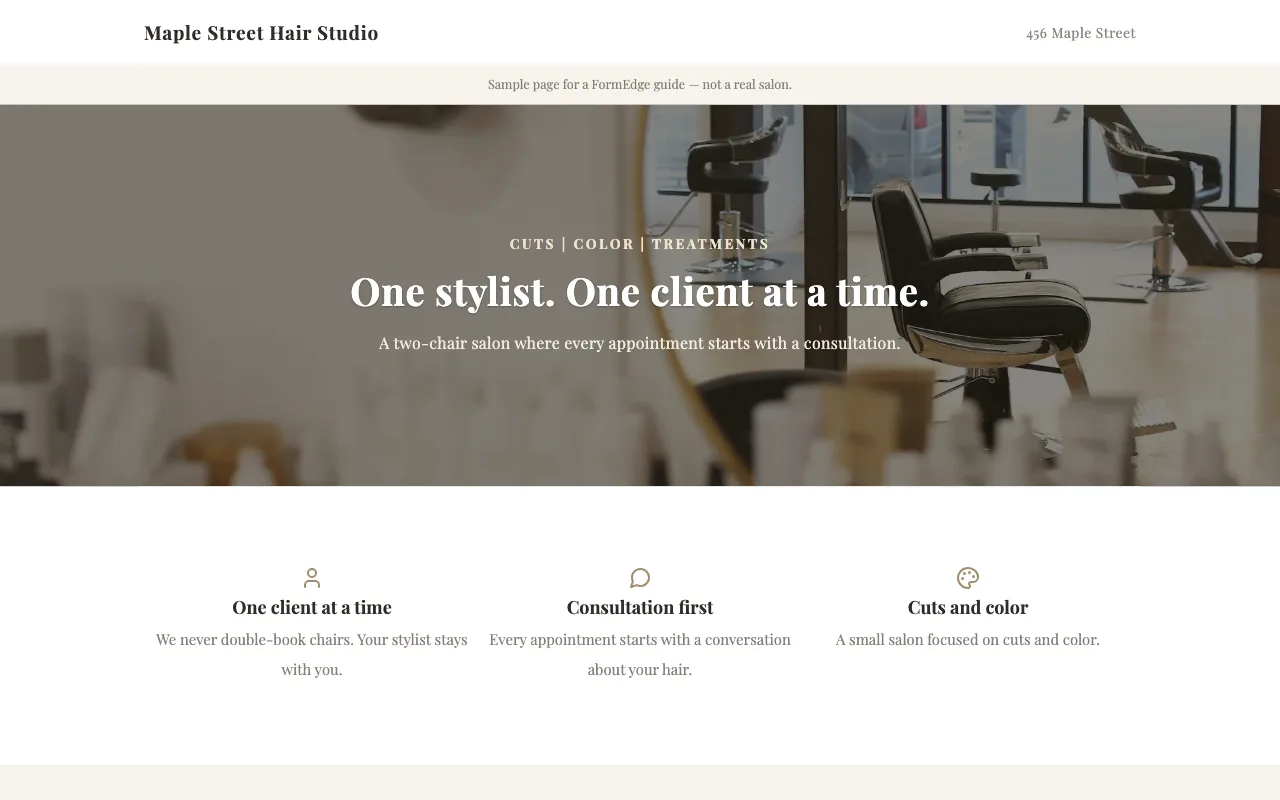
The example page built and published with this walkthrough You can open the example page that was built by following these steps. It is a fictional salon.
Make sure enquiries reach you
Last, set where the form sends a notification when someone submits it.
Prompt to paste
When someone submits the contact form, notify me by email at (your email address).
By default the email only tells you that a submission arrived. Ask ChatGPT to include the submitted content if you want it in the email; either way, every submission stays readable in the dashboard.
Paid plans can also notify Slack or LINE, or call an external system through a webhook.
Then submit the form once yourself and confirm that the notification reaches the address you set — a form nobody has tested is the most common way a new site quietly loses enquiries.
Going further than a contact form
Once the page is live, the same form can collect more than a message.
- Appointment requests — add the fields you need for a date, a time and a service. What arrives is a request, not a confirmed booking; you check the chair and reply.
- Payments — take card payments after submission as a fixed amount multiplied by a quantity, which suits deposits, class seats and prepaid packages.
Which one should you pick?
If you want to own the markup and you are comfortable moving files to a host, take the HTML and host it yourself. If the look matters most and you do not mind copying between windows, let ChatGPT write the words and assemble them in a builder. If what you need is a page at a real URL with a form that works today, connecting the app skips the parts that usually stall.
FAQ
- Can ChatGPT publish a website on its own?
- ChatGPT can write the page, but something has to host it at an address other people can open. Either you take the files to a host yourself, or you connect an app that publishes to a hosting service from the conversation.
- Why does a contact form need more than HTML?
- A form in plain HTML has nowhere to send what people type. Storing submissions, emailing you about them, and blocking spam all happen on a server, so you either write that yourself or use a service that provides it.
- Do I need a paid plan to connect ChatGPT to FormEdge?
- Connecting an AI agent over MCP requires the Starter plan or higher. You can still build and publish a page with a form on the free plan from the FormEdge dashboard.
- Will ChatGPT write the copy for my business correctly?
- It writes a draft. Facts such as hours, prices and addresses come from what you tell it, and anything you leave out may be filled in by guesswork. Read the page before you publish it.
Related reading
Publish a page with a working form
Start on the free plan — no credit card, no server to set up.
Get started freeNo credit card required · Free plan available